Why Does This Matter?
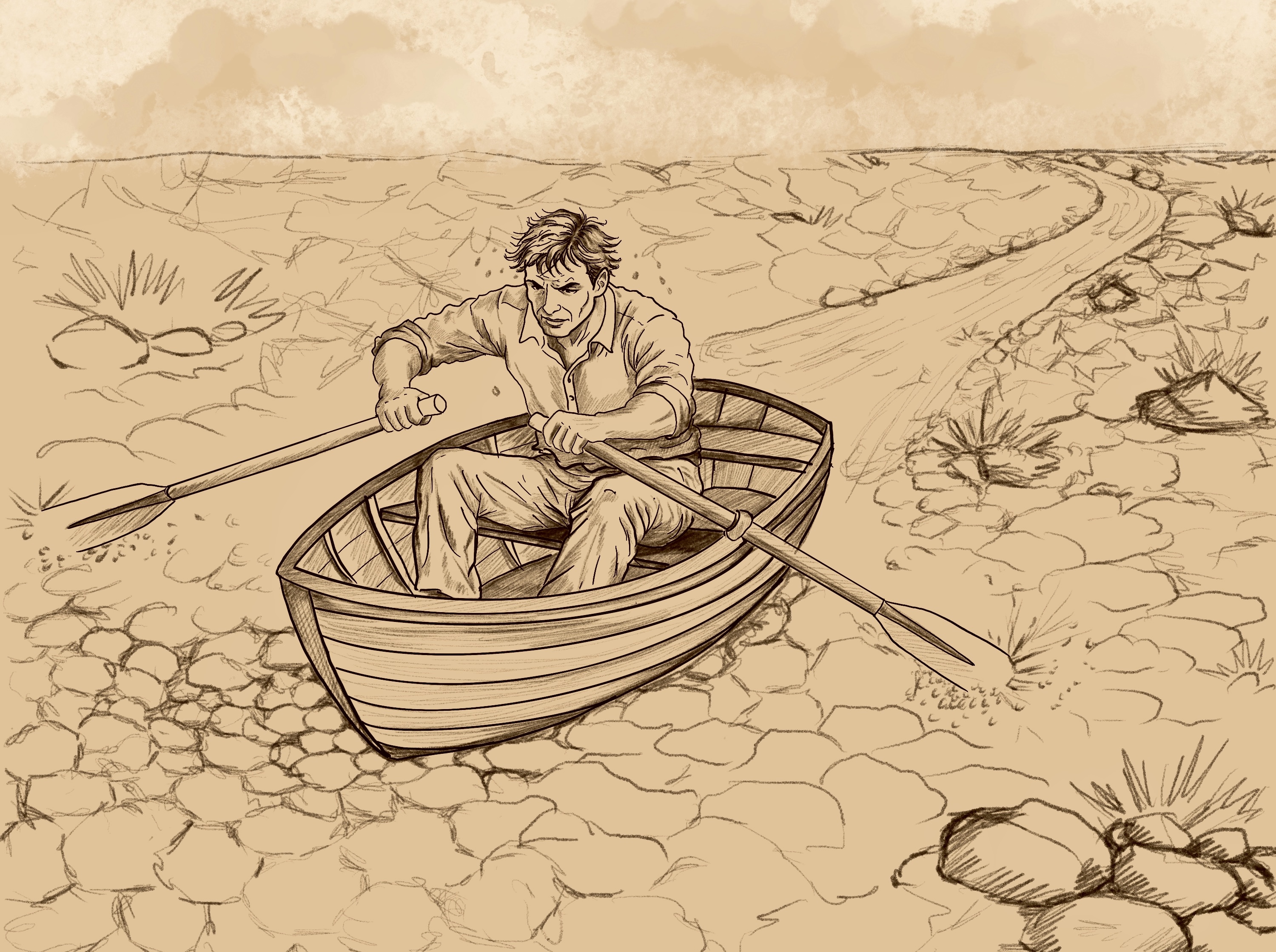
Image of the Week
Hand-drawn art by Rupali Bhuva
Image of the Week

I’ve been a graduate student in physics for almost three years, but I only recently figured out why. I had to tackle a simple question do so: Why does this matter?  I avoided asking myself this question because I knew the answer would be painful.

I ended up in physics through stubbornness, and an unusual willingness to suffer for the sake of grades. As an undergraduate, I was not particularly passionate about quarks, quasars, or quantum mechanics, but I was academically very competitive, and once I’d settled on physics as my major I determined to place myself at the top of my class. I did so by throwing myself into the hardest classes and putting in the hours required to ace the tests. This was, to put it mildly, a bad idea. I got a sort of grim pleasure from vanquishing my classmates in these academic slogs, but I was basically miserable. So why’d I keep it up?

When multiple people are striving towards a shared goal, they often rank themselves by progress within their peer group. This was my mistake — I swapped an absolute goal (figuring out how bits of nature work) with a relative one (scoring higher on tests than my classmates). Later, when I found myself unhappy, I couldn’t leave without feeling like I’d lost something. That social capital sunk cost was the first part of the trap I found myself in.

The second was a positive feedback loop that encouraged me to spend ever-increasing amounts of time on my work. Humans inherit convictions mimetically from each other — we learn what to value by imitating our peers. As my desire to excel academically grew, I spent greater amounts of time in and around the physics department. The more time I spent there, the greater my desire to excel. I’d never given physics much thought at all before my senior year in high school — but once I was surrounded by other physics students, competing for the same pool of grades and research positions, I could think of little else. This inherited desire was unchecked because I had no life outside of academics — no fixed reference point. Although quitting would have made me happier, I felt like I had nowhere to quit to. My tunnel vision left me with few concrete notions of alternative pursuits, and without a destination, I could not seriously contemplate leaving. 

Plans are never plausible until they contain specifics, and implausible plans tend to be discarded. Many of my peers in physics only added incredulity, consciously or otherwise. The result was a reality distortion field — quitting was not just painful, but unimaginable, unthinkable. I ended up in graduate school not because I wanted to toe the bleeding edge of natural science, but because I simply couldn’t imagine doing anything else.

That’s the mimetic trap in a nutshell: it hurts to leave, and there’s nowhere to go. It decouples the social reward signal from the rest of objective reality — you can spend years ascending ranks in a hierarchy without producing anything that the rest of humanity finds valuable. If you value the process itself, that’s fine. I didn’t. Cowardice kept me from acting on this, and after a while I came to believe I had to succeed in this field I’d fallen into essentially by chance.

“Why does this matter?” is an excellent way to gauge if you’ve drifted into a mimetic trap. If you find this question impossible to answer honestly, you’re probably wasting your time. Getting out is the hard part — that requires courage and diligent planning. It’s much easier to avoid falling in. But in either case, you’ll benefit from building a system that steers you towards productive, meaningful activity in the long run.

Seed Questions for Reflection

How do you relate to the notion that we can swap "absolute goals" for "relative ones" - that the measure of outpacing others can quietly replace the thing we thought we cared about in the first place? Can you share a personal story of a time when you realized you were climbing a ladder that was leaning against the wrong wall, or when you discovered you'd inherited a conviction mimetically without ever asking yourself "Why does this matter?" What helps you establish reference points outside the hierarchies you find yourself in - those places, practices, or relationships that remind you what you actually value when tunnel vision begins to set in?

Moved by this reading? Join a live Awakin Circle to discuss in community.
Join this week
More ways to connect

Add Your Reflection

11 Past Reflections
PO
Apr 14, 2026
This should be required reading for every entering college freshman - or better yet every high school junior before the end of that year.
RA
Apr 14, 2026
Very cool reflection. Memetic behavior is a very important one to understand for operating in this world, and to see how your own mind is being molded by it.
LS
Linda Sechrist
Apr 14, 2026
I'm certainly glad that I fell into or found what I value most as it has evolved me to where I am today. From writing news briefs to writing local articles, and finally to writing national feature articles for a magazine. I read my way to glimpses of Consciousness and a enhanced and much larger perspective of LIFE. I had to read the books of authors and comprehend what I was reading before I could interview them and ask intelligent questions. After 22 years I arrived where I'm supposed to be, collaborating with 3 other compassionate and conscious individuals who collaborate on a website that is all about Consciousness. I'm still interviewing people, such as Amit Goswami, who can say in all the right words what Consciousness is and how expanding/raising it makes a major difference in the way we perceive our fellow humans and live our lives. Our website, GrokingWholeness.info is free and so are all the articles, monthly newsletters and YouTube interviews on it. It matters because I AM ... View full comment
VP
Vd pooja
Apr 14, 2026
When I joined as a Nadi Vaidya my goal was to touch and change 1000 lives daily… to attain this from the last 22 yrs I have kept moving and finally last year was a time when I could do it. Looking back I realised I had stopped enjoying the healing and benefits i was spreading in the society to busy to even get time to reflect and acknowledge the present. Last few months have changed my number game to satisfaction and self reflection and although I am proud of my journey , somewhere I think for reaching the destination i stopped enjoying the Bful nuances it entails. So I relate to your article in totality and work towards a more humane approach and have changed my end goals as a 40 yr old which the 18 yr old in me didn’t understand much earlier
AM
Apr 9, 2026
Reflection: The Ladder and the Palm Yesterday, a photograph stopped me. An old wooden ladder leaned gently against a palm tree in Jamaica. No one climbing. No visible task. No urgency. Just… there. It brought back another image I kept in my New York office years ago— a yellow ladder floating in a wide blue sky from the Santa Fe Opera. Two ladders. Both unclaimed by purpose. And something in me softened. Because I know this other ladder too— the one we climb without questioning: achievement, recognition, progress, getting somewhere. The one that quietly turns presence into performance. In yoga, we’re given a simple invitation: nowhere to go, nothing to do. I’ve said those words countless times guiding others. But lately, I’m feeling them differently. Not as instruction— but as orientation. What if the ladder is still here… but we’re not required to climb it? What if it can simply lean— part of the landscape, not a ... View full comment
DD
Apr 3, 2026
Of course we can swap so-called absolute goals for relative ones. Outpacing others can replace the things we really care about. Those happen via conditioning, doing what we think we should, or not having the self-confidence or courage to do what we want. I was once on a career path that I and others wanted for me. I wasn't in it by chance; I was in it by conditioning and choice. I was succeeding and had a bright future; when I no longer wanted it, I anguished over getting out and going in a different direction. I didn't know where I was going, but there are always other places to go. While making the change cost me, it was liberating and transforming for me. What helps me more than anything is to be honest with myself and pursue what I want, not what others expect. My feelings and my heart are my best reference points.
JD
Apr 2, 2026
There are times when I need to make important choices in my life. If I make a wrong choice it affects not only me but other people in my life. How I make wise choices is very important to me. It is not always easy to make wise choices. There have been times in my life when it was difficult for me to make the right choices. When I make a wrong choice it hurts not only me but also people connected with me. This is a great dilemma for me. I believe in telling the truth. Telling the truth is like a two edged sword. It hurts me and creates wounds and hurts the person whom I love. Normally I do not encounter such situations. But there are times when I run into such situations. I believe in telling the truth even though it may cause emotional pain in me as well as in others close to my heart. Truth indeed triumphs, not lies.-Satymeva jayate na nrutam. Following the truth is not always easy. We need to be aware of the wrong direction we are travelling. We need to be aware of the wro... View full comment
AM
Apr 2, 2026
This reflection feels very real to me—the quiet way we can exchange an “absolute” orientation for a “relative” one without noticing. In my case, it didn’t show up in physics, but in a much more intimate terrain. Years ago, after nearly two decades of deep healing, my husband suddenly became seriously ill again. In an instant, something old and visceral was activated in me—a root-level fear I recognized from my own near-death experiences in my twenties. On the surface, I was doing what was needed—caring, organizing, holding things together. But underneath, I could feel a shift: from simply being present… to subtly measuring myself. Am I doing this well enough? Am I holding this together the “right” way? That was the moment I recognized the ladder. And that it wasn’t leaning where my heart actually was. What helped wasn’t leaving, but returning. Returning to simple reference points: • feeling my feet when fear surged • allowing emot... View full comment
AN
Anne Apr 14, 2026
Thank you Allie. You put words to small shifts that can be seismic. The shift between "relational presence" and performative, measurable presence As an older person who is preparing to marry another older person, we have spent hours talking about what we need from ourselves and each other other when things are hard. We have discovered the quiet safe space that relational presence creates. The way that sitting with each other and quietly supporting the movement of emotions through is changing the way we move through the world, as a couple and as individuals. Thank you for your insightful post and language you bring to shifts that can be difficult to name.
B
BarbaraS. Apr 14, 2026
Dear Allie, thank you for this thoughtful post. It reminds me of Ram Das who spoke of caring for his father in his end of life phase and others who he was with at the end. He went from caregiver to being a human being sharing in this experience and understanding the suffering that was happening. He then was able to sit with them and help them come to terms peacefully. From caregiver role to human role of sharing this experience.
RO
Rohit
Apr 2, 2026
wow, really powerful. "It decouples the social reward signal from the rest of objective reality — you can spend years ascending ranks in a hierarchy without producing anything that the rest of humanity finds valuable. "