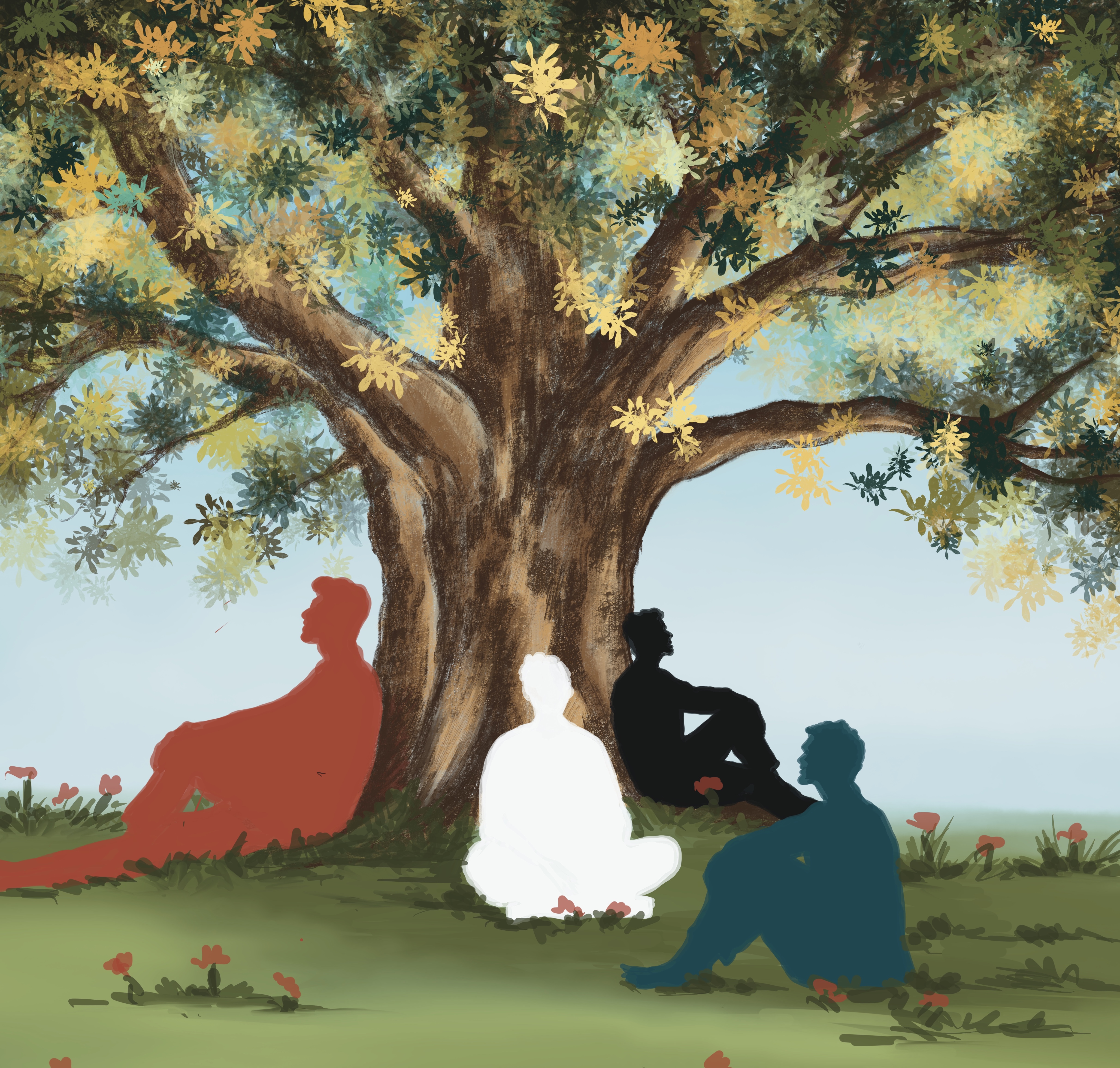
The great leader never feels it is us versus them. He or she is for everybody. To be for one interest group is never to be against another. To be for those without power is surely not to be against those with power.
Provincialism occurs frequently in personal situations of conflict We hear the tale of two of our friends. One seems to be the victim. One seems to be right, the other wrong, and we easily withdraw empathy from the "villain."
Suppose our assessment of the situation is accurate, although this may be highly questionable. The villain of this moment is the victim of an earlier moment. Because I'm deeply for one, why should I be against the other? Why can't I be deeply for both? If I am absolutely unyielding in my attitude favoring one over the other, I am diminishing the freedom of attitude on the part of other people. In so doing I am limiting my capacity for leadership.
I can find ultimate meaning in my call and in that of which I am a part—and at the same time enhance other facets of the whole to which I belong. I will never hurt the particular that I'm called to by being a part of the whole and enhancing the whole. What I need for my particular will always flow back to me if I am giving myself to the whole.
We must do nothing that in any way diminishes another.
What do you make of the idea that "the villain of this moment is the victim of an earlier moment" - that seeing someone's wrongdoing might actually be an invitation to widen our compassion rather than withdraw it? Can you share a personal story of a time when you found yourself holding space for both sides in a conflict? What helps you stay connected to the wholeness of a situation when everything in you wants to label someone as right or wrong, hero or villain?
When we were Kids, We all used to dislike Villains But when we grow as adults, we understand Villains well. Villains are broken beings who had a terrible & painful past
This reflection is reminding ma a lot about my life at AURO University as there are people taking advantage of me just because i am a good guy and If I stand up for myself & saying No to some faculties there. They see me as a Villain. I am forced to do honuors there but I don't even want to do, I have 0 interest to do & it dosen't bring me any joy to continue in AURO. I am already honoured in my heart & mind, thats enough. No matter what I am fighting back. I only wanted to do a 3 year B.A program. I am also facing family pressure at the same time.
I only wanted a 3 year B.A degree thats all
I am battling University Pressure & Family Pressure at the same time, Its like the whole world is against me.
My advice is if people are telling you to do something you don't want to do even if its for your own good. Just listen to your Soul & do what makes you happy. take the advices & opinions out of your ear. Just Move on.
I have been doing this a lot just listening to my so... View full comment
This reflection is reminding ma a lot about my life at AURO University as there are people taking advantage of me just because i am a good guy and If I stand up for myself & saying No to some faculties there. They see me as a Villain. I am forced to do honuors there but I don't even want to do, I have 0 interest to do & it dosen't bring me any joy to continue in AURO. I am already honoured in my heart & mind, thats enough. No matter what I am fighting back. I only wanted to do a 3 year B.A program. I am also facing family pressure at the same time.
I only wanted a 3 year B.A degree thats all
I am battling University Pressure & Family Pressure at the same time, Its like the whole world is against me.
My advice is if people are telling you to do something you don't want to do even if its for your own good. Just listen to your Soul & do what makes you happy. take the advices & opinions out of your ear. Just Move on.
I have been doing this a lot just listening to my soul Hide full comment
This reflection reminded me of a difficult situation between two roommates who were both my best friends individually. One of them was repeatedly absent from college because of health issues and other personal struggles. As a result, teachers became upset, and sometimes I was also scolded because I was associated with her.
When she came to me and shared how hurt she felt, I initially focused on the problems her absence was creating for everyone else. It seemed obvious who was right and who was wrong. However, after listening to her, I realized that she was carrying a lot of pain that many of us did not fully understand. She felt judged, isolated, and unsupported at a time when she was already struggling physically and emotionally.
At the same time, I could also understand the frustration of the other friend and the teachers. They were concerned about attendance, responsibilities, and the impact her absence was having on others. Both sides were hurting in different ways.
Readin... View full comment
This reflection reminded me of a difficult situation between two roommates who were both my best friends individually. One of them was repeatedly absent from college because of health issues and other personal struggles. As a result, teachers became upset, and sometimes I was also scolded because I was associated with her.
When she came to me and shared how hurt she felt, I initially focused on the problems her absence was creating for everyone else. It seemed obvious who was right and who was wrong. However, after listening to her, I realized that she was carrying a lot of pain that many of us did not fully understand. She felt judged, isolated, and unsupported at a time when she was already struggling physically and emotionally.
At the same time, I could also understand the frustration of the other friend and the teachers. They were concerned about attendance, responsibilities, and the impact her absence was having on others. Both sides were hurting in different ways.
Reading the line, "the villain of this moment is the victim of an earlier moment," helped me see the situation differently. Instead of choosing one side, I tried to hold compassion for everyone involved. My friend who seemed difficult was actually feeling abandoned and misunderstood, while the others were reacting to challenges they were facing themselves.
This experience taught me that conflicts are rarely as simple as "us versus them." People often act from places of pain, fear, or disappointment. When I resist labeling someone as the villain and instead try to understand their story, I become more compassionate and better able to support everyone involved. It reminds me that true friendship and leadership require empathy for all sides, not just the side that seems right. Hide full comment
RK
Ravinder KomaragiriJun 19, 2026
Tatvi, this story so resonates with me. These were our bachelor times, working our first jobs, in a new place to all of us. We stayed together to share a large apartment. This was the most economical option and whatever fights we had between friends / room mates, we never split nor compromised on the accommodation. There was sulking for a few days but eventually all the parties came out of it.
One particular situation where two of my room mates had arguments and I was in between silently being pulled to support one side. Both were my friends and each were right in their perspective. The problem was they weren't able to find the common ground. Neither could I in that heat of the moment. I let them into one of our rooms and locked it from the outside, saying that I'll not open the door till they find that common ground themselves. It took them about an hour.
Later I learnt that theirs was a silly argument about "who pinched first"? Once I reframed it in this manner all of us had a big laugh 😃
I couldn't agree more. This perspective requires both deep self-knowledge and mindful awareness of our reactions. It requires empathy for the experience of being human and "skillful" means in addressing issues and conflict. It requires the ability to think critically and at times to carefully analyze. I am very pleased that this perspective is being supported and brought forth. Creating enemies, holding ill will, blaming without understanding; all are the building blocks of disharmony and endless conflict. Though there are times when we must act to protect, we do not need to do so with hate. Thank you.
I 100% agree with the notion of "the villain of this moment is the victim of an earlier moment". One tends to behave or act based on his or her previous experiences and exposures.
When we are born, we all are neutral blank human being. We all turn out to be who we are now is based on family where we are born, area or town or country we are born, school where we learned, friends we had, community in which we grew, and so many factors. Sometimes we get tough with or dislike certain people (so called villains) based on social and other norms, but instead we need to be open hearted and compassionate, realising that if we would have been brought up in those circumstances, we would not have been much different from them. We need to understand why this person is behaving like this.
SS
Shivani Singhal
Jun 15, 2026
This is so powerful. And it's left me curious about how this is held in balance with the need to take decisions to remove someone from a situation, or to remove oneself from a situation, because of a lack of safety or similar. How do we balance the practicalities and needs of a group and a team, with a deep compassion and acknowledgement of the wholeness of each individual and each situation.
I'm tussling with this at work right now - and whilst I have compassion and empathy (maybe not as much as I would hope to have) with some of the folks in question, it's making it harder for me to make some important decisions. Would love any wisdom on this from others who've walked this path.
DD
David DoaneJun 19, 2026
I'll venture a response to your request: I think the situation you are describing is complex and difficult. I guess what you are saying is whether to remove the other or remove self from a situation because of a lack of safety. In my experience, my first effort is to engage in a conversation with the other in which I say what I am experiencing openly, honestly, and with care, listen to the other’s response, and repeat the process. If the other is open and cooperative, a way for both to work together in the situation may be worked out. If the other is not open and cooperative, or if there is no progress, or if there is a lack of safety, I think a separation is the way to go. If I am the boss or supervisor, I’d probably remove the other from the situation. If the situation is between peers on the same level, I’d probably remove myself from the situation. These are my thoughts; I'm not at all saying what you should do. I wish you well with your decisions.
I agree that the villain of this moment is the victim of an earlier moment. I agree that it's important to widen our compassion. For me that means to appreciate that we are systems more than we are individuals. In my career I made an effort to be of help to many couples. When there is conflict, we blame, don't see our part in the problem, don't take responsibility, and play pin the tail on the donkey. We see one as villain and the other as victim rather than look at how two created the situation. "Tweedle Dum and Tweedle Dee agreed to have a battle" as said in Through the Looking Glass. We do the same game of blaming and divisiveness at the level of national politics as we do at the level of personal relationships. When I remember that we are one whole system that is basic and much bigger than our divisiveness, that helps me keep in check my wanting to label 'us' as right and good and 'them' as wrong or bad.
RK
Ravinder KomaragiriJun 19, 2026
Dear David, I would frame this situation "who pinched first"? And pain is perceived differently, a disrespectful word may hurt one more than a hard slap he may get. The 'victim' and 'villain' have different perspectives and definitions of these two words.
DH
Dielle Hamilton
Jun 13, 2026
I have not taken much time with this new topic, but I have a friend who does an NPR podcast called Us & Them. Links aren't allowed here, but you can easily find it. It emanates from West Virginia Public Broadcasting and Peabody Award-winning public radio producer Trey Kay, who listens to people on both sides of the divide & tells stories from the fault lines that separate Americans.
I have had many conversations about how I find the phrase unhelpful & separating, choosing to try to heal the divide that seems ever-widening rather than accentuate the fault lines. I will find the time to return here as I certainly appreciate the seed question & invite you to check out my friend's podcast.
As a digital immigrant, I sometimes feel the sting of not being able to follow directions that others seem to navigate with ease. In those moments, it is easy to feel left behind.
Yet I am learning to see this with greater gentleness. I come from a different landscape of learning, one shaped by books, conversations, handwritten notes, and lived experience. The digital world asks for new forms of attention and fluency.
Rather than a deficit, I am beginning to see this as an invitation—to remain humble, curious, and willing to learn. It has also deepened my appreciation for patience and for the kindness of those who help bridge the gap between different generations of ways of knowing.
This reminds me of my dream that I was Trumps caretaker! I was at first appalled but then remembered I had read the NYT story about his father and how he had accounts/ businesses in baby Trumps name. It's not his fault he is who he is or the others who desire power and greed over human health and connection. I don't know how to fix it except lead by example. After an angry woman on the phone cussed and fussed about me honking my horn to make sure she was paying attention enough not to hit my car. I left a note saying "I apologize, you needed a hug not a honk". She looked like family and we all have been in a heightened emotional state on the go.
"The great leader never feels it is us versus them. He or she is for everybody. To be for one interest group is never to be against another. To be for those without power is surely not to be against those with power."
In a world so hyper-focused on politics, it would do us all good to apply this to ourselves collectively. Rather than should-ing on whatever nonsense we are watching in the arena and whichever person holds the leader title, if we truly belived this AND honestly walked this, the circus of hatred that current day politics thrive one could not be sustained.
That saying hurt people hurt people is accurate. As a counselor, I address these things often. Let's look underneath that action, what triggers or wounds were you reacting from? How can you choose differently next time. It's compassion from me and learning compassion for themselves so they can learn and start anew.
Reality or Truth is One. It is not Two. Reading this passage authored by N. Gordan Cosby reminds me of an ancient saying written in Sanskrit. Ekam Satyam bahudha vadanti. Truth is One expressed by sages in different ways. Sadly some of us may not perceive the Reality as One. Such a way of perceiving the Truth and not following it has caused divisiveness and battles and wars. We see such battles and wars between two nations, USA and Iran causing destruction on both sides.
Sadly we see such divisiveness in families, communities and nations. How many battles and wars have been created and how much damage and destruction has been created. UNO has been created to unite nations of the world for peace. Sadly the UNO has not been able to achieve it.
It is time to wake up. It is time to join heads, hands and hearts and learn to relate to each other as brothers and sisters. A couple of years ago I had visited Auroville, a relatively small town in the southern part of India. I was happily s... View full comment
Reality or Truth is One. It is not Two. Reading this passage authored by N. Gordan Cosby reminds me of an ancient saying written in Sanskrit. Ekam Satyam bahudha vadanti. Truth is One expressed by sages in different ways. Sadly some of us may not perceive the Reality as One. Such a way of perceiving the Truth and not following it has caused divisiveness and battles and wars. We see such battles and wars between two nations, USA and Iran causing destruction on both sides.
Sadly we see such divisiveness in families, communities and nations. How many battles and wars have been created and how much damage and destruction has been created. UNO has been created to unite nations of the world for peace. Sadly the UNO has not been able to achieve it.
It is time to wake up. It is time to join heads, hands and hearts and learn to relate to each other as brothers and sisters. A couple of years ago I had visited Auroville, a relatively small town in the southern part of India. I was happily surprised to see people from many countries of the world living together, helping others and taking care of each other. It is like a pilgrimage. Auroville has been considered an ideal town by the UNESCO. I hope and pray we will wake up, loin hands and work together for universal peace. We create Auroville in the community we live in. Slowly but surely we will attain our goal.
Namaste!
Jagdish P Dave Hide full comment