Three Supports For Turning Towards Mystery
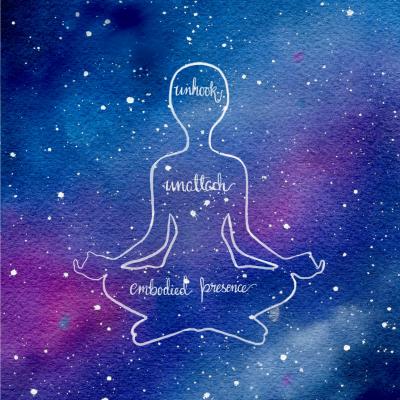
Image of the Week
Hand-drawn art by Rupali Bhuva
Image of the Week

There are three primary supports for nonconceptual awareness. These three supports are obvious in many ways, and yet, their simplicity belies their extraordinary depth. Over the last thirty years of my own practice, I have found that these three elements continuously reveal their potency and possibility. 

The first nonconceptual support is embodied presence. Embodied presence is a way of compensating for the tendency to be lost in abstraction. This practice requires us to listen from within, to listen not with our ears, not with our mind, but to listen with ourselves. While you’re sitting here now, while you’re reading and reflecting on this teaching, let yourself listen from within, with the whole of your sensory awareness. Allow yourself to feel the sense of being here—how your feet touch the ground, the length of your spine.  

This means getting in touch with whatever tension patterns may have formed. We’re often holding some kind of unconscious habitual tension patterns in our jaw, forehead, or shoulders. Embodied presence is a way of meeting our tensions physically; connecting the dots for the kind of attitudes, mental states, and emotional patterns that keep those tensions going; and then softening them. Embodied presence is an invitation to soften, settle, relax, and open up to what’s here. When we’re driven along by our habitual thinking patterns, we hold onto those tensions. A free body is a relaxed body, an open body. The foundation of all of our not knowing, of all our deeper, freer ways of knowing, is embodied presence.  

The second helpful support for nonconceptual awareness is building the capacity and the willingness to continue letting go of the various ways our attention is seduced. It’s normal for the mind to think. It’s as normal for the mind to think as it is for the eyes to see and the ears to hear. Thinking is the mind’s job, so it’s going to continue producing thoughts. Let’s not fight that. 

In moments when we notice that our attention has been seduced, we often get discouraged. “Oh, no, I’ve been distracted again.” Or we think, “Oh, I’ve been distracted. I’m supposed to go back to being present, but maybe just in a minute… I kind of love this thought.” When you see that your attention has gone off into abstraction, absorbed into some idea or image, drop the thought. Without judgment, blame, or drama, simply drop it. Then, it becomes more possible and fluid to return to embodied presence. Awareness is way more potent, luminous, and immediate than all our mental prevarications. So when you find yourself caught up in a thought, notice it, and in the noticing, unhook, unhook, unhook. The more you unhook from your familiar modes of thinking, the more you give yourself the chance to land in the unfamiliar mode of not knowing.  

The third important support for nonconceptual awareness is the willingness to not know. The willingness to put aside the familiar. The willingness to meet each experience anew. For example, we’ve been talking about listening from within, sensing the contact of our legs on the ground, and noticing tension patterns that arise. We can easily filter those experiences through a regular habitual discourse: these are my legs, these are my shoulders, here’s some tension, I should let it go. That familiar narration may be running in the background anyway. That’s fine. But what if you didn’t rely on the description of arms and legs, hot and cold, comfortable or uncomfortable? 

Instead, you can just come into the fizzing of all this, the mysteriousness. What is here right now isn’t arms and legs and torso. What’s here right now is this aliveness. My usual ideas will tell me what my body is, where my body is, and how my body is. But this kind of unfamiliar contact, this nonconceptual contact, will show me the constant flickering of experience. My ideas will tell me where my body ends and where the world begins, but this willingness to meet experience in an unfamiliar mode tells me that experience is ageless. In the same way that sensations—what I call inner experience—happen, here in awareness, so too do sounds—or outer experience. This third support for nonconceptual presence is about letting experience be here in awareness. It’s about letting awareness be the primary ground, reference point, and container for experience. And all the rest—inner or outer, pleasant or unpleasant, good or bad, meditatively suitable or meditatively unacceptable—all of that can just be left aside. 

Through this practice, we give ourselves a chance to taste the unfamiliar, to taste experience anew. In that newness, we find more depth, more dimensionality, more insight, and a greater capacity to meet what happens fully and freely. And so, our practice deepens.

Seed Questions for Reflection

What does nonconceptual awareness mean to you? Can you share a personal story of a time you experienced nonconceptual awareness through one of the three helpful supports: embodied presence, willingness to let go of the various ways we get distracted, and the willingness to not know? What helps you open up to mystery?

Moved by this reading? Join a live Awakin Circle to discuss in community.
Join this week
More ways to connect

Add Your Reflection

10 Past Reflections
HA
Feb 28, 2024
What nonconceptual awareness means to me is what the late J Krishnamurti taught me: to look at something non-verbally. Usually we look at a flower or any object including living beings by naming them, i.e. through a word. We have practically created an image in our minds about everything in the phenomenal world, and we observe them through that image. We never question whether the 'observer' is an imagined non-entity or a real entity.
In the moments of my intense observation, I have often felt that the 'observer' and the 'observed' have merged in each other; in fact, only the 'observed' remains and the 'observer' takes a backseat, rather passes into oblivion and anonymity.
MT
Feb 28, 2024
In embodied presence and choosing to return to this when I noticed I had got lost in thoughts, I experienced an amazing sense of love at the centre of my being - my core support the skeleton supporting my body. I witnessed habitual tensions and was able to consciously choose to relax. I witnessed pain and experienced how it shifts and changes.
I’m not big on naming things as it tends to become a ‘thing’ to do - I prefer to become aware of their nature. However ‘Non conceptual awareness’ invites one into the mystery of being and awakens the senses or reveals the sensations that are there.

Cultivating the ‘don’t know’ attention with curiousity opens a door to what is, with new eyes, ears and senses. It unveils the pure essence of life and invites one to engage deeply in its heart.
A powerful opportunity to reconnect to one’s body, core, to life, to heart and to be, just be.

AN
Feb 27, 2024
I love the metaphors non conceptual awareness is the food not the menu, the territory not the map, and so it goes, nothing can be said and yet there is always the intention to let everything drop away with wise or indeed true attention. Freedom from...... when entangled in..... we fill in the blanks to remain in separate subject/object relationship until we die from being someone dissolving back into being the vastness itself. I am so grateful for this guidance, this re-minding, these dialogues, this connection but most of all grateful to be everything that is alive - boundless and spacious as well as small restricted and human .
JP
Feb 23, 2024
I love this passage written by Martin Allyward. My understanding of living a holisic life is enriched by reading and reflecting on this passage. According to me, noncocptual awareness is awareness beyond the knowledge acquired from books, teachers and other sources. Nonconceptual awareness is cultivated by experiencing the unconditional Truth, the unconditional Love, and by living in here-now consciousness. It is beyond words, conceptt and theories. I consider it as living Truth. It goes beyond conceptual learning acqired from books, teachers and other resources. It is an experiential learning gained by reading books or lstening to teachers attentively with an open mind, reflecting on the teachings, practicing the words of wisdom, and icorporating the teachongs in everyday life. The author describes three helpful supports for nonconceptual awareness. The first support is embodied awareness. Conceptual awarenes by itself is not enough. Learning lessons from books or tteachers i... View full comment
DD
Feb 23, 2024
Nonconceptual awareness is awareness without conceptualizing. It's the food, to use Alan Watt's metaphor, not the menu.
Awareness through embodied presence is awareness of and through bodily, sensual, and emotional experience. I have experienced nonconceptual awareness through embodied presence, being aware of what I am experiencing in my body in the moment when with myself and with another. I have related to another what I am experiencing bodily in response to the other, and it is very opening of new perspectives and possibilities. To me, mystery is the unknown and getting a glimpse of what it holds. What helps me open to the mystery is embodied presence, appreciating the aliveness in mystery, and letting myself be purposeless.
FI
Feb 23, 2024
These concepts are so well defined here. I realize the skill of my yoga teachers in this practice and how they took time to lead us consistently in this direction every sit. Steeped in Buddhist traditions they have passed these instructions to me, to all of us. And so we carry the teachings along the path. I’ve taken to practicing outdoors. How it amplifies the speed at which one can drop into that space of no conceptual awareness.
RA
Feb 23, 2024
an awareness of obkective observation will take into account, the form, the sound , the shape of things,
ST
Feb 22, 2024
AHHHH! ONE PLACE I LOVE TO GO IS A LONG ISOLATED BEACH. I TAKE OFF MY CLOTHES AND DO YOGA AND THEN BURY MYSELF IN SAND AND SOMETIMES CLOSE MY EYES AND SOMETIMES LOOK AT THE SKY. AFTER SOMETIME, MAYBE AN HOUR OR MORE I APPROACH THE SEA AND ENTER AND SWIM AND FLOAT SOMETIMES FOR HOURS AND SING AND CHANT. I BECOME MYSTERY .
DA
Feb 22, 2024
Well said. However, there's a bit of an implied contradiction between two and three. As you mention, it's the mind's nature to be thinking thoughts. By "dropping thought", I don't think you intend to imply try to stop thinking. Instead, it's dropping the attachment to the babble. As you then mention "unhook, unhook..." Then it aligns with three.

Not knowing is really about softening the minds need to know, to feel in control. This is an effect of the identified ego. It knows it's not in charge but wants to give us the illusion that it is. That way, it can maintain it's position. When clarity arises, it can even try to thwart that so it doesn't lose it's position.

I'd suggest there's also a 4th. The Yoga Sutra tells us the key is samadhi. (transcendence, turiya) By going beyond the mind, we touch into presence. Plus the deep rest allows purification. This is the key for culturing presence, on which the three above depend. For samadhi, I recommend an effortless meditation.
GI
Ginger Mar 5, 2024
But by dropping thoughts you are in samadhi state and mindless