Do What You Please, But I'm Watching

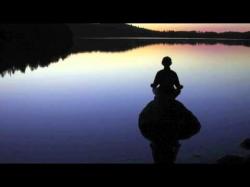
Alone, in a quiet place, muscularly relaxed (lying down or comfortably seated), I watch the emergence within myself of mental images, permitting my imagination to produce whatever it likes. It is as though I were saying to my image-making mind, 'Do what you please; but I am going to watch you doing it.'
As long as one maintains this attitude – or, more exactly, this relaxation of any kind of attitude – the imagination produces nothing and its screen remains blank, free of all images. I am then in a state of pure voluntary attention, without any image to capture it. I am not paying attention to anything in particular; I am paying attention to anything which might turn up, but which in fact does not turn up. As soon as there is a weakening of my voluntary effort of pure attention, thoughts (images) make their appearance. I do not notice the fact immediately, for my attention is momentarily asleep; but after a certain time I perceive what has happened. I discover that I have started to think of this and that. The moment I make this discovery, I say to my imagination, 'So you want to talk to me about that. Go ahead; I'm listening.' Immediately everything stops again, and I become conscious of the stoppage. At first the moments of pure attention are short. (Little by little, however, they tend to become longer.) But, though brief, they are not mere infinitesimal instants; they possess a certain duration and continuity.
Persevering practice of the exercise gradually builds up a mental automatism which acts as a curb on the natural automatisms of the imagination. This curb is created consciously and voluntarily; but to the extent that the habit has been built up, it acts automatically.
The principle of the liberative method is now clear. Man triumphs over his imaginative automatisms, not by pitting himself against them, but by consciously allowing them free play; his attitude towards them is one of active neutrality. His final triumph is the end-product of a struggle in which his voluntary attention does not itself have to take part. (Such participation, it may be added, is incompatible with its pure, impartial nature.) Man rules by dividing; refusing to take sides with any of his mental forces, he permits them to neutralize one another. It is not for Divine Reason to overthrow nature, but to place itself above nature; and when it succeeds in taking this exalted position, nature will joyously submit.
What does refusing to take sides with any of your mental forces mean to you? Can you share a personal story of a time you exercised an attitude of active neutrality toward your own 'imaginative automatisms'? What is a mental automatism you have developed to help you curb the natural automatisms of the imagination?